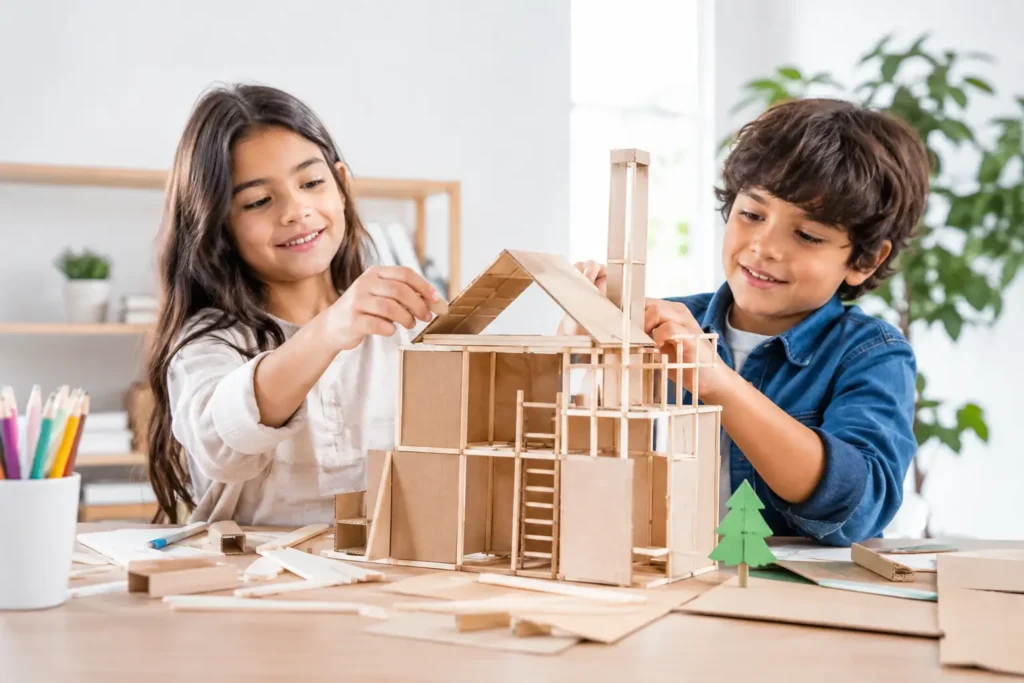
A cardboard tube becomes a tower. A scrap of paper becomes a bridge. Then a child asks the question that changes the whole project: “But how will people get inside?” That is where architecture art projects kids can truly come alive. They are not simply about making a pretty building. They invite children to observe, plan, test ideas, solve problems, and tell stories through space.
For parents, this matters because a child who designs a place is practicing more than art. They are making decisions, imagining another person’s experience, and learning that a first idea can change. A leaning tower, a tiny doorway, or a roof that will not stay up is not a failure to tidy away. It is a useful moment of discovery.
Why Architecture Art Projects Help Kids Think
Architecture gives art a real-world anchor. Children see buildings every day: apartment blocks, schools, shops, playgrounds, mosques, train stations, and homes. When they begin looking closely, they notice that buildings are made of shapes, lines, textures, colors, and choices.
A project might begin with a question: Why are some windows large and some small? What makes a building feel safe, welcoming, busy, or quiet? How does a staircase help people move through a space? These questions build visual awareness while making room for imagination.
Unlike a step-by-step craft with one expected result, architecture-based art allows many good answers. One child may design a jungle library raised on stilts. Another may create a peaceful house with a garden on the roof. A third may build a noisy monster hotel with a slide instead of stairs. Each idea can be guided with thoughtful questions rather than corrected into sameness.
That child-led approach is valuable, but guidance still matters. Young artists need adults who can introduce basic ideas such as balance, scale, structure, pattern, and perspective. The goal is not to make them copy an adult’s model. It is to give them enough tools to make their own choices with growing confidence.
Start With Looking, Not Building
The strongest architecture projects begin before the glue, paint, and cardboard appear. Encourage children to look at a building as an artist would. Notice its silhouette against the sky. Look for repeated windows, curved arches, tall columns, shadowy entrances, and rough or smooth surfaces.
A short neighborhood walk can become a rich visual lesson. Choose one building and ask your child to sketch only its outline. On another day, focus on doors. On another, photograph or draw interesting rooflines. This slows down the urge to make something quickly and strengthens observation, which sits at the roots of good art-making.
Art history and cultural discovery can deepen the experience, too. Compare the strong geometric forms of a modern building with the decorative details of a historic temple or traditional home. The purpose is not to turn children into mini architects overnight. It is to show them that people in different places and times have designed spaces according to climate, materials, beliefs, needs, and imagination.
Architecture Art Projects for Kids by Age
The best project depends on a child’s developmental stage. A four-year-old needs a very different invitation from a preteen who is ready to plan a detailed city block. The materials may overlap, but the learning focus should grow with the child.
Ages 4-6: Build a Place for a Story
For younger children, architecture should feel physical, playful, and open-ended. Offer boxes, paper tubes, masking tape, fabric scraps, large blocks, and washable paint. Invite them to create a home for a character: a sleepy dragon, a tiny mouse, a friendly monster, or themselves.
Use prompts that spark storytelling. Where does the character sleep? Is there a window to look at the moon? How does it get to the second floor? What happens when it rains? Their answers may be wonderfully impractical, and that is part of the joy. At this age, the aim is spatial awareness, vocabulary, fine-motor development, and the confidence to turn an idea into something visible.
Avoid taking over when the tape wrinkles or the roof sags. Offer help with a difficult join, then return ownership to the child. A slightly wobbly house made with pride teaches more than a perfect model built by an adult.
Ages 7-9: Design a Building With a Purpose
Children in this stage can begin connecting form to function. Give them a simple design challenge: create a reading nook, animal shelter, treehouse, art museum, or playground for an imaginary community.
Ask them to make a quick plan before construction. It can be a loose drawing rather than a formal blueprint. They might label a door, add a garden, or decide where people will sit. As they build, encourage revision. If the entrance is too narrow for the paper figure they made, what could change? If the bridge collapses, would a wider base help?
This is where architecture becomes a gentle lesson in resilience. Children learn that artists and designers do not always get it right on the first try. They observe, adjust, and try again.
Ages 9-13+: Create a Mini City or Meaningful Space
Older children and early teens are often ready for more technical challenge and personal expression. They can explore scale, one-point perspective, floor plans, facades, and model-making with recycled materials. A city project works especially well because it blends independent ideas with collaborative planning.
One student might design a music venue, while another creates a public park, bookstore, transit stop, or apartment building. Together, they must consider roads, pathways, public spaces, and how people move through the city. This naturally introduces negotiation and systems thinking without making the lesson feel like a lecture.
For teens interested in design, media, or future creative pathways, architecture projects can become portfolio-worthy explorations. The most meaningful work is not necessarily the neatest. A strong piece shows research, sketches, experiments, revisions, and a clear point of view.
Materials That Encourage Real Experimentation
Expensive supplies are not required. In fact, recycled materials often invite more inventive thinking because children must respond to what is available. Keep a small collection of clean boxes, cardboard, paper cups, tubes, foam trays, yarn, craft sticks, tissue paper, tape, glue, markers, and paint.
The trade-off is that recycled materials can be harder to cut and attach. Younger children will need safe, age-appropriate tools and close supervision. If the goal is architectural drawing rather than construction, plain paper, a ruler, pencils, colored pencils, and black markers may be more useful than a crowded craft table.
Materials should serve the idea. A child making a futuristic tower may need foil and transparent packaging. A child drawing an old neighborhood shop may need layered pencil shading and careful observation. There is no single “right” medium for architecture art.
Questions That Keep the Project Child-Led
The words adults use can either widen a child’s thinking or quietly narrow it. Instead of asking, “What is it supposed to be?” try asking, “Tell me about this part.” Instead of saying, “That roof should be straight,” ask, “What kind of roof did you imagine?”
Helpful questions include: Who uses this space? How do they enter? What happens here during the day? What would you change if you made it again? Which part feels most like you?
These questions show children that their ideas deserve attention. They also help parents see beyond the final object. A model may look messy on the table, yet carry a thoughtful story about community, nature, safety, play, or belonging.
Let the Building Show the Journey
A finished architecture project does not need to resemble a professional model to be valuable. The taped corners, changed plans, paint marks, and surprising additions are evidence of a child thinking with their hands. When adults focus only on a polished result, children can become cautious. They may wait for instructions instead of trusting their own observations.
At Monsters Art Studio, structured fine-art learning makes space for both foundations and freedom. Children can learn to notice lines, shapes, buildings, and visual references while still packing their imagination into every project. The process may be messy, but it is purposeful.
The next time your child turns a box into a building, pause before offering a solution. Ask who might live there, what the space needs, and what they want to try next. Their small cardboard structure may be the beginning of a much bigger habit: looking at the world closely and believing they have something original to add to it.