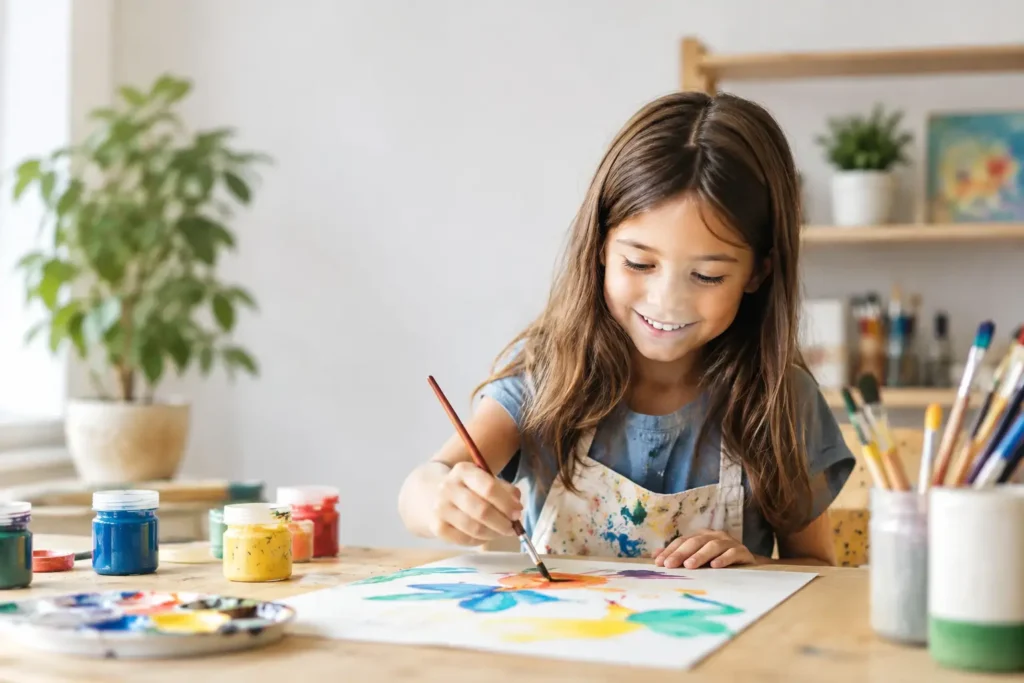
A child spends twenty minutes mixing a muddy new shade of green, then uses it to paint a creature nobody else would have imagined. The painting may not match the sample on the table. It may not look polished in the way adults expect. But the child has observed, decided, adjusted, and persisted. That is the real work happening in child led art classes.
For parents, this approach can feel refreshingly different from the familiar craft model: everyone follows the same steps, makes the same project, and goes home with nearly identical results. A child-led class does not leave children to “just do whatever.” It gives them meaningful choices inside a thoughtful learning structure, so their skills and their creative voice can grow together.
What Child Led Art Classes Mean
Child-led art is not the absence of teaching. It is teaching that respects the child as the maker of their own work.
The instructor brings carefully chosen materials, a clear artistic focus, technical demonstrations, visual references, stories, and questions. A lesson might explore line, texture, warm and cool color, buildings from a particular culture, animals in motion, or the expressive portraits of an artist from history. Children are then invited to interpret the idea rather than reproduce an adult’s version of it.
That distinction matters. One child may respond to a lesson on architecture by drawing a glowing treehouse with crooked windows. Another may make a careful city scene. Both can be learning perspective, shape, pattern, and composition. Their work looks different because their thinking is different.
At Monsters Art Studio, this balance is central to the ARTRU™ Teaching Method. Children receive real fine-art foundations while keeping ownership of their ideas. The goal is not a wall of matching artworks. It is a room full of young artists who can look closely, make decisions, and explain the choices they made.
Why Process Matters More Than a Perfect Result
A polished project can be satisfying. There is nothing wrong with children feeling proud of a finished piece. The concern begins when the final result becomes the only measure of success.
When adults correct every uneven line, choose every color, or quietly finish difficult sections, children learn a discouraging lesson: art is only worthwhile when it looks adult-approved. They may become hesitant to begin without help. They may avoid unusual ideas because mistakes feel risky.
Process-based learning gives children room to experiment without turning every experiment into a performance. They discover that paint can be layered, that charcoal can create dramatic shadows, that a torn collage edge can be more interesting than a neat one, and that an awkward first attempt can become the start of a stronger idea.
This builds more than artistic confidence. It develops focus, problem-solving, flexibility, and emotional expression. A child who learns to ask, “What could I try next?” is practicing a useful habit for school, friendships, and life beyond the studio.
Structure Gives Creativity Roots
Some parents worry that child-led learning means loose, chaotic sessions with little progress. Good child-led art classes are the opposite. Freedom works best when it has roots.
A skilled instructor plans a progression. Younger children may begin by noticing simple shapes, experimenting with mark-making, and building confidence with paint, clay, and collage. As they grow, they can explore proportion, color relationships, composition, observation, art history, and more challenging materials. Older students can develop personal themes while strengthening the techniques needed to communicate them clearly.
The structure comes from the learning objective, not from forcing identical outcomes. If the lesson is about texture, each child might create a different imaginary landscape, but everyone is guided to notice and use rough, smooth, repeated, layered, or patterned marks. If the lesson is about proportion, students might draw different faces or figures, yet each practices the same underlying visual relationships.
This is why quality instruction matters. Children deserve more than a tray of supplies and a vague invitation to be creative. They need an educator who knows when to demonstrate, when to ask a thoughtful question, when to introduce a new challenge, and when to step back.
Guidance Without Taking Over
The best classroom support often sounds like a conversation. Instead of saying, “Draw it like this,” an instructor might ask, “Where do you want your viewer to look first?” or “What happens if this shape becomes larger?”
That approach still offers help. A child struggling with a brush can learn how to load it with paint. A student frustrated by a drawing can be shown how to break a complicated form into simpler shapes. The difference is that the teacher supports the child’s next decision rather than replacing it with their own.
What Children Gain at Different Ages
Child-led learning changes as children grow. A four-year-old and a thirteen-year-old both need creative ownership, but they need different kinds of challenge.
For ages 4 to 6, art is often physical and sensory. Children learn through squeezing, pressing, swirling, tearing, layering, and telling stories about what they have made. The instructor helps them name what they see, build vocabulary, strengthen hand control, and feel safe making a joyful mess. At this stage, confidence is a major foundation. A child who believes, “I can make things,” is more willing to keep learning.
For ages 7 to 9, children are often ready to notice more detail and make more intentional choices. They can begin connecting observation with imagination: looking carefully at leaves, animals, buildings, or objects, then transforming what they notice into their own visual worlds. They benefit from technical tools, but still need permission to be playful and bold.
From ages 9 through the early teen years, students can handle deeper conversations about composition, meaning, artistic influences, and visual communication. They may start to recognize preferences in subject matter and materials. Some will be drawn to illustration, design, architecture, animation, or media. Others will simply find art to be a steady place to think and express themselves. In both cases, a foundation in observation and independent decision-making is valuable.
How Parents Can Recognize a Strong Program
A child-led studio should feel welcoming, but it should also show evidence of purposeful teaching. Look beyond the display wall. Ask what children are learning, how projects are adapted for different ages, and how instructors respond when a child gets stuck.
You should expect to hear about skills as well as self-expression. Strong programs can explain how children learn to use materials, observe the world, understand artistic concepts, and develop ideas over time. They can also explain why every artwork does not need to look the same.
It helps to notice the language used in class. Are children being praised only for making something “beautiful,” or are they being encouraged for trying, noticing, revising, and making brave choices? Specific encouragement is more powerful than generic praise. “You used darker marks to make that corner feel stormy” tells a child that their decision was seen.
There is one trade-off worth accepting: child-led artwork can be unpredictable. Some weeks, a child may bring home a piece you immediately understand. Other weeks, they may bring home an unusual cardboard creature, a dark abstract painting, or a drawing that is more meaningful to them than it appears at first glance. Ask them about it. Their explanation may reveal a whole story, an experiment, or a problem they solved independently.
Let the Artwork Belong to the Child
Children do not need every art experience to become a future career path. They need places where their ideas are taken seriously, their hands are trusted, and mistakes are allowed to become discoveries.
When a child brings home work that is unmistakably their own, resist the urge to improve it. Put it somewhere they can see it, ask what they enjoyed making, and let that small, strange, vivid creation remind them of something essential: their imagination is worth following.