When the school calendar opens up, children do not need another week of being told exactly what to make. The best holiday art camps give them room to slow down, get their hands messy, follow an idea that surprises them, and discover that their own choices matter.
A painted creature with uneven legs, a cardboard city that leans slightly to one side, or a drawing that changes halfway through can all be signs of real learning. Art camp is not about sending home a matching set of parent-approved projects. It is a chance for children to build creative roots through observation, experimentation, and the courage to try again.
What Should Holiday Art Camps Actually Teach?
A holiday program can be joyful without being random. Children deserve the pleasure of free exploration, but they also benefit from an experienced teacher who knows when to introduce a new tool, ask a useful question, or demonstrate a technique that helps an idea grow.
Strong holiday art camps balance structure with freedom. A thoughtful theme might lead children through storytelling, nature, architecture, a famous artist, or a cultural tradition. Within that theme, they should still have meaningful decisions to make: Which materials fit their idea? What colors create the mood they want? How can they solve the problem when their first plan does not work?
These decisions are not small. They teach children to observe carefully, think independently, and trust that uncertainty is part of making something original. A camp that supplies every template and corrects every “mistake” may look tidy at pickup time, but it can leave very little room for a child’s own imagination.
Technique Gives Ideas Somewhere to Go
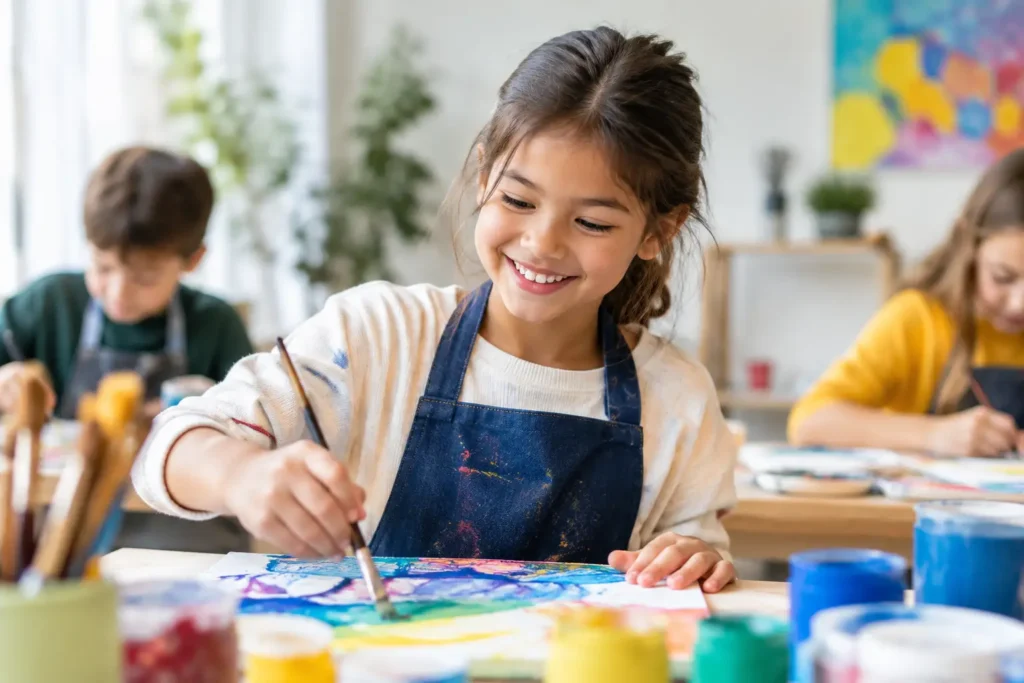
Creative freedom is not the same as being left without guidance. Children are often more confident when they know how to mix color, create texture, use a brush with control, build a stable form, or draw what they actually see.
Technical foundations give young artists more ways to express themselves. A child who learns how light changes the look of an object can make more intentional choices in a painting. A child who understands simple perspective can turn a favorite imaginary place into a believable world. Skill does not reduce imagination. It helps imagination travel farther.
The right level of challenge depends on age and experience. Younger children may explore line, shape, sensory materials, and story through playful making. Older children can begin developing observation, composition, visual references, and more sustained projects. Teenagers may be ready to connect artmaking to design, illustration, media, or future creative pathways.
Why the Process Matters More Than the Perfect Piece
Parents naturally want to see what their child has made. A finished artwork can be a beautiful window into a week of discovery. But the most valuable part of camp often happens before the final piece is carried home.
It happens when a child decides to cover an unsuccessful drawing and start again. It happens when they notice that blue and orange feel more exciting together than they expected. It happens when they explain the strange little monster in their sculpture and realize they have invented a whole story around it.
Process-based art education teaches resilience in a gentle, practical way. Not every experiment works. Paint may spread differently than planned. Clay may crack. A collage may feel too crowded. With patient guidance, these moments become invitations to notice, adapt, and make another decision rather than reasons to give up.
That is why a camp should not be judged only by whether every child produces a polished result. Uniform outcomes often mean that adults made most of the important decisions. Individual work, including work that is messy or unexpected, tells a different story: this child was thinking.
How to Choose a Holiday Art Camp for Your Child
Start by looking beyond the theme. A “space adventure” or “jungle week” can be exciting, but the teaching approach is what determines whether children are simply completing crafts or genuinely growing as artists.
Ask how instructors support different ages and confidence levels. A four-year-old needs a very different learning environment from a 10-year-old, even if both are exploring the same broad idea. Younger children need movement, sensory discovery, simple language, and plenty of reassurance. Older children often enjoy longer projects, more complex materials, and the chance to explain the thinking behind their work.
It also helps to ask whether children are encouraged to make their own choices. Will they work from a fixed sample, or will they be guided to develop a personal response? Are instructors teaching art skills as they go? Is there time to revisit an idea, rather than rushing every project to completion before the day ends?
A welcoming environment matters just as much. Children take creative risks when they feel safe from comparison. They should be able to say, “I do not know what to do yet,” without embarrassment. They should hear feedback that notices effort and thinking, not only neatness. “Tell me about this part” can be far more powerful than “Make it prettier.”
What Children Bring Home From Art Camp
The artwork may go on the refrigerator, the bedroom wall, or into a treasured folder. Yet the deeper takeaways are often less visible.
Children return from a meaningful camp with a stronger sense of agency. They have practiced beginning without knowing every answer. They have learned that materials can be explored, ideas can change, and their point of view is worth developing. For children who are shy, art can offer another language for sharing what they notice and feel. For children who are energetic or easily frustrated, it can become a place to focus, persist, and channel that energy into making.
There is also the social side of camp. Creating alongside other children helps young artists see that there is more than one way to respond to a prompt. One child may build a tiny house from recycled materials while another makes a giant creature. Neither needs to be “better.” They are different solutions to the same creative invitation.
For families, school breaks can be busy and unpredictable. It is reasonable to value a camp that provides dependable care, clear routines, and a joyful day. But when art education is thoughtfully planned, it offers more than a helpful schedule. It gives children a pocket of time where curiosity is taken seriously.
A Week Can Start a Longer Creative Journey
A holiday camp does not need to turn every child into a professional artist. Its job is simpler and more meaningful: to help children experience art as something they can return to throughout their lives.
Some children will leave wanting to draw every day. Others may discover that they love building, painting, inventing characters, or learning why artists make the choices they do. A teenager might begin to see a connection between a favorite sketchbook habit and future studies in design or media. Each outcome is valid.
At Monsters Art Studio, this is why seasonal programs are built around guided discovery rather than copy-and-paste results. Children need both strong foundations and permission to be wonderfully, productively unsure. Their ideas do not have to look perfect to be worth following.
When you choose a camp, look for the place where your child can make a glorious mess, ask unusual questions, and leave with more than a finished project. Pack their imagination, give them room to experiment, and let the next creative journey begin.