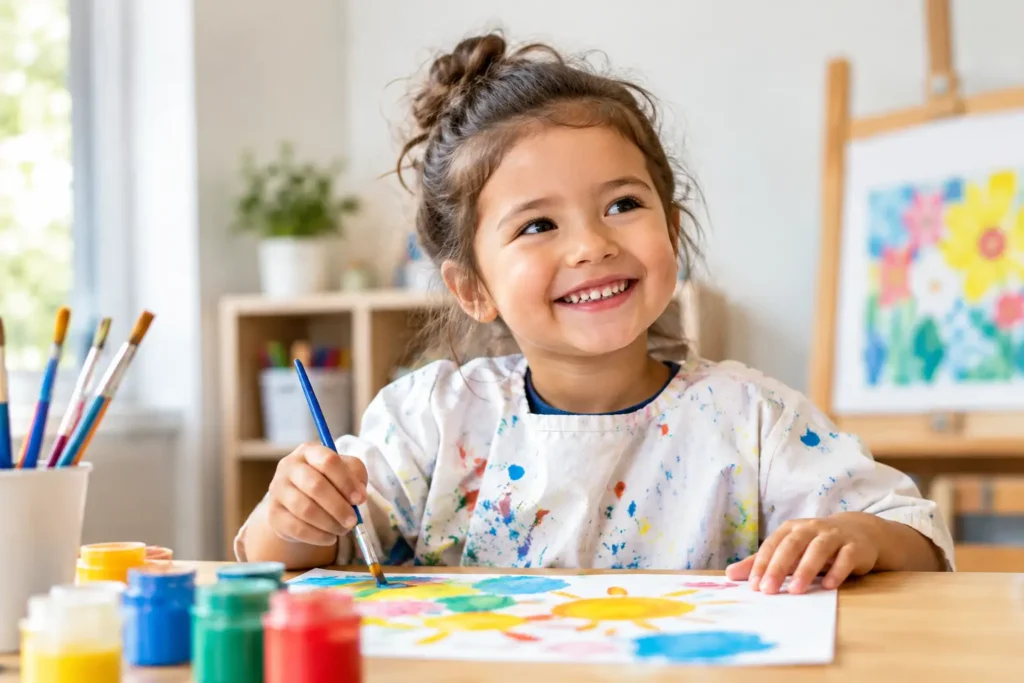
A preschooler presses a too-large brush into blue paint, watches it drip, and decides the paper needs a giant storm. That decision matters. The best art classes for preschoolers do not rush in to correct the drip or turn the storm into something adults recognize. They give children time, materials, language, and gentle guidance to find out what happens next.
For children ages 4 to 6, art is not a performance. It is a way of thinking with their hands. A line can become a road, a monster, or a feeling. Clay can be squeezed, rolled, flattened, and transformed. Paint can be layered, mixed, and changed when a child changes their mind. These small creative choices are where confidence begins to grow.
Why Preschool Art Needs More Than a Cute Craft
There is nothing wrong with enjoying a holiday craft at home. But a single project with one expected result is not the same as art education. When every child is asked to make the same bunny, flower, or handprint, the adult’s plan can become more important than the child’s ideas.
Thoughtful preschool art classes make room for a different kind of learning. Children are introduced to real artistic tools and foundations in age-appropriate ways: line, shape, color, texture, pattern, composition, and observation. They learn that artists look closely, notice details, make choices, and experiment when something does not work as planned.
This does not mean preschoolers need formal lectures or complicated rules. It means the learning has intention. A teacher might invite children to look at how an artist used dots, then let them invent their own dot-filled world. They might study the shapes in a building, read a story about a faraway place, or use natural objects as inspiration before creating. The experience stays playful, but play has roots.
What Children Learn Through Messy, Joyful Making
At this age, the finished artwork tells only part of the story. The deeper learning happens in the moments before it: choosing a color, figuring out how to attach two pieces of paper, trying again after paint spreads somewhere unexpected, or explaining why a creature has seven eyes.
Confidence Through Real Decisions
Preschoolers spend much of their day following directions. Art gives them a valuable space to lead. When a child chooses materials, creates their own imagery, and sees that their ideas are taken seriously, they begin to trust their judgment.
That trust does not come from hearing, “Perfect!” after every mark. It grows when an instructor says, “Tell me about this part,” or “What could you try next?” Children learn that their voice has value, even when their work looks different from everyone else’s.
Focus Without Pressure
Many parents notice that a child who moves quickly between activities can stay absorbed in art for surprising lengths of time. That is because making offers a natural reason to concentrate. The child wants to finish the collage, add one more window to the drawing, or solve the problem of a sculpture that will not stand up.
Focus should not be forced. A well-paced class alternates between looking, listening, moving, and making. Preschoolers need clear routines, short demonstrations, and enough freedom to stay engaged. The goal is not to make them sit still for an hour. It is to help them build the joyful habit of staying with an idea.
Language, Emotional Expression, and Social Growth
Art gives young children another way to communicate before they have all the words they need. A child may not say they felt nervous at school, but they may draw a tiny figure under a huge dark cloud. Another may create a loud, bright painting because it feels exciting. Neither needs to be interpreted too quickly. What matters is that the child has a safe way to express and talk about what they made.
In a small group, children also practice sharing space and materials. They see that one friend used purple for a tree while another used green, and both choices are allowed. They learn to wait for a tool, describe their work, listen to other ideas, and celebrate difference. These are early lessons in empathy as much as creativity.
What to Look for in Art Classes for Preschoolers
Not every class serves young children in the same way. Some are designed mainly for quick entertainment, while others are built as a progressive learning experience. The right fit depends on your child, your family’s schedule, and what you hope art will offer them.
Look first at the classroom atmosphere. Preschoolers need a welcoming environment where messy exploration is expected, not treated as a problem. They also need instructors who understand early childhood development. A teacher should be able to demonstrate a technique clearly while recognizing when to step back and let a child wrestle with an idea.
Materials matter, too. Children deserve more than pre-cut templates and washable markers alone. Age-appropriate paint, drawing tools, collage materials, clay, printmaking surfaces, and textured objects invite different kinds of discovery. Using varied materials builds hand strength and coordination, but it also teaches children that there is more than one way to make an image.
Ask whether the program has a thoughtful progression. Strong classes revisit ideas over time. A child may begin by noticing lines in nature, later use line to show movement, and eventually make a drawing that tells a story. Repetition with fresh challenges helps skills take root without making learning feel repetitive.
Finally, pay attention to how artwork is discussed. If the focus is always on whether a piece looks neat, realistic, or parent-approved, children may learn to fear mistakes. If teachers ask about process, choices, observations, and stories, children learn that art is a place for original thinking.
A Gentle Structure Makes Freedom Possible
Some parents hear “child-led” and picture total chaos. Real creative freedom is not the absence of structure. Preschoolers flourish when a class has a predictable rhythm: a warm welcome, an intriguing visual prompt or story, a short skill demonstration, generous making time, and a calm moment to share or reflect.
Within that structure, children can make meaningful choices. Everyone may explore texture, for example, but one child might build a rubbing from leaves while another makes a textured imaginary animal. The shared theme creates belonging. The individual decisions create ownership.
At Monsters Art Studio, the ARTRU Teaching Method is designed around this balance. Children are invited into a creative journey that combines technical foundations with observation, visual learning, art history, cultural discovery, storytelling, and hands-on experimentation. For preschoolers, those big ideas are introduced through experiences they can touch, see, and imagine.
A lesson about architecture might become a playful investigation of doors, windows, and towers. A look at an artist’s use of color might lead to a painted world no adult could have predicted. The point is not to produce miniature adult artists. It is to help each child become a more curious, capable maker.
How Parents Can Support the Creative Journey
The most helpful question after class is often not, “What is it?” Try, “What did you enjoy making?” or “Which material felt interesting today?” These questions tell children that the process matters. They also open the door to richer conversations than a guess about what the picture represents.
When your child brings work home, resist the urge to fix it, finish it, or suggest what it should become. A lopsided circle, muddy color mix, or pile of glued paper may hold a whole afternoon of discovery. Display it if you can, but do not feel pressure to keep every piece forever. A photo and a short note about what your child said can preserve the memory while making room for the next creation.
You can also carry the spirit of class into daily life. Notice patterns on a walk, collect interesting packaging for a collage box, look closely at shadows, or invite your child to draw while telling a story. No elaborate setup is required. Curiosity grows through small, repeated invitations.
The Artwork Is Not the Only Thing Growing
A preschool art class will sometimes send home a painting that looks like a storm, a dinosaur, a pile of colors, or something delightfully impossible to name. That is not a failure of instruction. It may be evidence that a child took a risk, followed an idea, and discovered that they can make choices of their own.
Give them a place where paint can drip, monsters can have seven eyes, and questions are welcome. The artwork may change from week to week. The courage to create can stay with them much longer.