A child stares at a painting of a bowl of fruit, then notices the shadows are purple instead of black. Another sees a building with soaring arches and asks how anyone could make stone feel like it is floating. Those are the moments when art history becomes more than names and dates. The best art history lessons kids experience give them a reason to look longer, ask braver questions, and try their own ideas.
For children, art history should not feel like a test about famous artists. It is a rich collection of human stories: people making images to celebrate, remember, protest, imagine, decorate, and understand their world. When taught alongside hands-on artmaking, it gives young artists roots as well as room to grow.
Why art history belongs in a child’s art education
Technical skills matter. Children benefit from learning how to hold a brush, mix color, draw what they observe, and build a composition. But technique without context can become a set of instructions to follow. Art history helps children understand that every artist makes choices, and that they can make choices too.
A painting, sculpture, textile, or building can open conversations about place, materials, beliefs, family life, nature, and identity. A child may be drawn to the patterns in a Japanese woodblock print, the movement in a Degas dancer, or the bold shapes of a contemporary mural. Their response does not have to be the same as an adult’s response to be meaningful. In fact, their fresh observations often lead to the most interesting discussions.
This kind of learning builds visual literacy. Children become more able to notice line, shape, texture, scale, mood, and symbolism. They begin to recognize that an image can communicate without using words. That skill supports not only future art study, but also reading, design thinking, media awareness, and confident self-expression.
Art history also makes room for cultural discovery without treating cultures as costumes or quick craft themes. Rather than making one “traditional” object and moving on, children can explore who made the work, what materials were available, what stories it carries, and how artists continue to create in that tradition today. Curiosity grows deeper when it is paired with respect.
What good art history lessons for kids look like
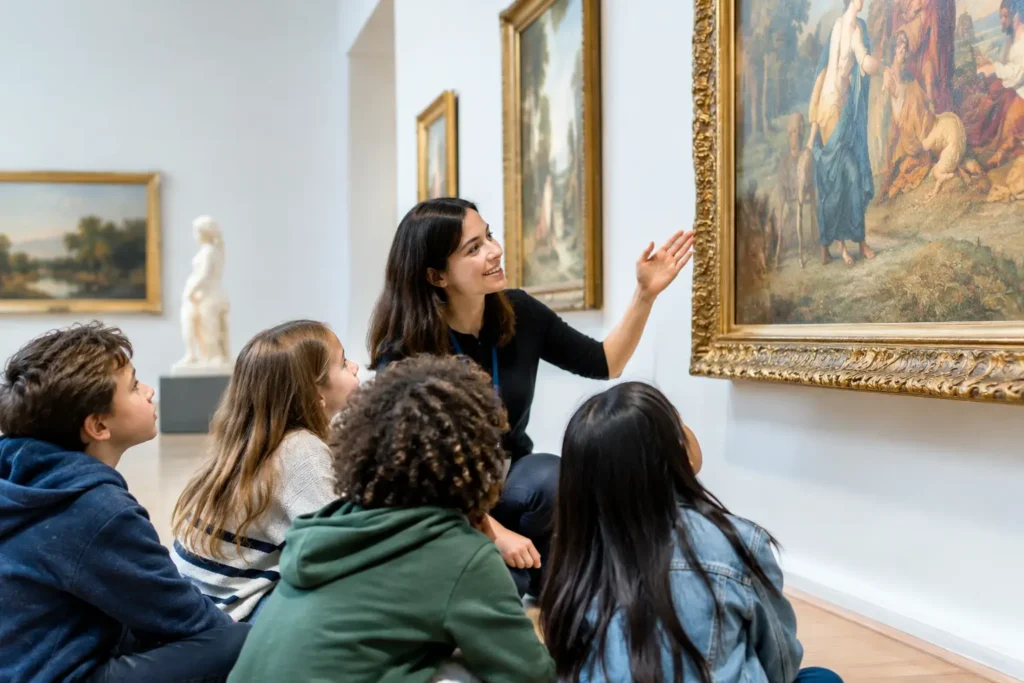
Good lessons begin with looking, not lecturing. Before an instructor explains an artwork, children need time to notice it for themselves. What catches their eye first? Where does their attention travel? What do they think is happening? What makes the work feel quiet, wild, funny, strange, or powerful?
There is no need to force a single correct answer. A teacher can introduce useful information after children have had a chance to form their own ideas. Knowing that an artist worked in a particular time or place gives the work context, but it should expand a child’s thinking rather than close it down.
The next step is making. If children study the energetic marks of Vincent van Gogh, they might experiment with thick paint, directional brushstrokes, and colors that express a feeling. If they investigate ancient architecture, they might build a small structure and test which shapes create strength. The goal is not to copy a masterpiece so neatly that every page looks alike. It is to borrow a question, a material idea, or a visual problem and answer it in a personal way.
That difference matters. A parent-approved replica may look impressive on a wall, but it does not always show what a child noticed, decided, revised, or discovered. Process-based art education values the crooked first attempt, the color change halfway through, and the unexpected solution. Those are signs that real thinking is happening.
Questions are more valuable than quick facts
Children do enjoy memorable facts. Learning that some artists painted outdoors, that murals can transform a neighborhood, or that stained glass tells stories through light can spark excitement. Still, facts work best when they lead somewhere.
Instead of asking only, “Who made this?” a thoughtful lesson asks, “Why might the artist have chosen this color?” “What would change if this artwork were much larger?” or “What story would you tell using only shapes?” These questions invite observation and imagination at the same time.
The instructor’s role is not to hand children a perfect interpretation. It is to provide vocabulary, demonstrate possibilities, and make a safe space for different viewpoints. A child who learns that their ideas are worth exploring is more likely to take creative risks later.
A journey that changes with age
Art history can begin much earlier than many parents expect, but the approach must fit the child’s developmental stage. A four-year-old does not need a timeline of art movements. They need a vivid image, a sensory material, a short story, and permission to play.
Ages 4-6: stories, senses, and big discoveries
For young children, art history is most powerful when it feels like entering a story. They may explore cave paintings by imagining the glow of firelight on a wall, notice animal shapes, and make marks with earthy materials. They can look at a garden painting, name the colors they find, and create their own imaginary growing place.
At this age, the learning is rooted in language, observation, motor development, and delight. Short discussions work better than long explanations. Children should touch safe materials, move their bodies, tell stories, and make choices. Their work may be messy, joyful, and unlike anyone else’s. That is exactly as it should be.
Ages 7-9: noticing choices and trying techniques
Children in this stage are ready to compare artworks and identify visual elements with more confidence. They can talk about foreground and background, warm and cool colors, repeated patterns, and the way a line can suggest movement.
They can also begin to connect an artist’s choices to their own. After looking at portraiture, they might create a self-portrait that includes symbols of what matters to them. After studying a cityscape, they may design a neighborhood that solves a problem they care about. The lesson becomes less about copying what has been seen and more about using observation as a springboard.
Ages 9-13+: context, creative identity, and stronger skills
Older children and early teens can handle more complex questions. They may discuss how art reflects social change, how artists challenge expectations, or how architecture shapes the way people move through a space. They can compare different viewpoints and recognize that art history is not one narrow story told by only a few famous names.
This is also a valuable age for strengthening technical foundations. Perspective, proportion, composition, mixed media, and design principles give students more control over the ideas they want to express. For teens considering design, animation, architecture, or other creative pathways, art history provides reference points and a stronger visual vocabulary.
At Monsters Art Studio, the ARTRU™ Teaching Method brings these threads together: observation, skill-building, cultural discovery, storytelling, and experimentation. Children are guided by instructors, but the final decisions remain theirs. That balance gives them both structure and ownership.
How parents can support the learning at home
You do not need to become an art historian or buy special supplies. The most helpful thing a parent can do is take a child’s observations seriously. When they show you a drawing inspired by a lesson, try asking what they noticed in the artwork they studied, what they changed, or what part felt difficult.
Avoid jumping straight to “What is it?” or “That looks just like the example.” Those questions can accidentally suggest that recognizable results are the only measure of success. Try, “Tell me about this part,” “What made you choose these colors?” or “What would you try differently next time?” A child learns that art is a conversation, not a performance.
Museums, public murals, illustrated books, historic buildings, and even product packaging can become opportunities for looking. A five-minute conversation in front of an interesting image is often enough. Keep it light. Notice together, wonder together, and let uncertainty be part of the fun.
The long-term value is not a list of artists
A child may not remember every date or art movement they encounter. What stays with them is the habit of paying attention. They learn that a painting can hold a question, that a building can tell a story, and that their own work can begin with an observation nobody else made.
That is the real gift of art history: it gives children a larger creative family while protecting their right to have an original voice. Pack their imagination, offer them a work worth looking at, and let their next question lead the journey.