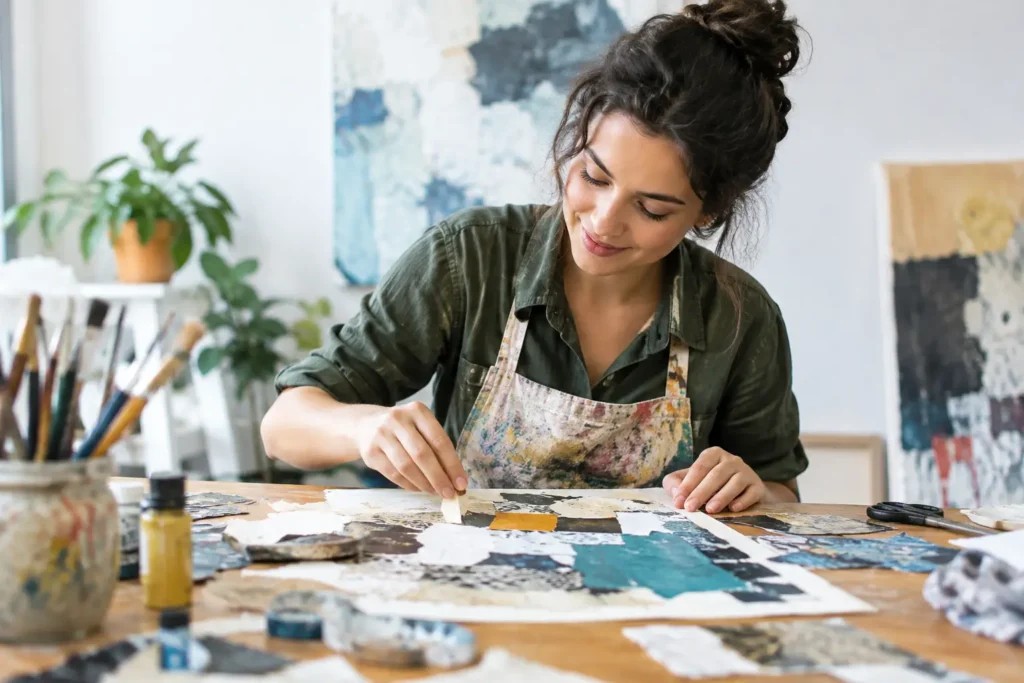
A child presses tissue paper into wet paint, scratches a line through pastel, then decides the whole picture needs a cardboard moon. That decision matters. In mixed media art classes, children learn that art is not about following a sample perfectly. It is about noticing possibilities, making choices, trying again, and discovering what their own ideas can become.
For parents, mixed media can look wonderfully messy – and sometimes a little mysterious. Why use paint, paper, fabric, ink, found textures, and drawing tools in one artwork? Because each material asks a child to think differently. A pencil invites observation. Paint encourages movement and color mixing. Collage develops composition. Texture asks young artists to slow down, touch, compare, and experiment.
When these materials are guided by a thoughtful curriculum, the mess has purpose. Children build technical foundations while growing the confidence to say, “I chose this.”
What Mixed Media Art Classes Teach Beyond Craft
Mixed media is the practice of combining more than one art material or process in a single artwork. It might pair watercolor with pen, acrylic paint with collage, clay texture with drawing, or printmaking with storytelling. The possibilities are broad, but good teaching gives children a clear creative path rather than simply placing a pile of supplies on the table.
A meaningful class begins with a question, image, artist, place, story, or observation. Children may study how an illustrator creates atmosphere, look closely at the pattern of leaves, imagine a creature’s habitat, or explore the shapes of a famous building. Then they learn techniques that help them respond to that starting point in their own way.
This matters because a child can make a colorful project without learning much from it. If every student is told where each piece goes, what colors to use, and when to stop, the final work may look polished, but the child has practiced compliance more than creativity. Mixed media becomes powerful when children are supported to test ideas, solve visual problems, and take ownership of the result.
Why Different Materials Build Different Thinking
Children do not learn in one straight line. Some think through stories. Some begin with color. Some need to touch and arrange materials before an idea appears. Others observe quietly, then make a bold change near the end. Working across media gives more children a way into the creative process.
Drawing develops looking skills. Children learn to notice proportion, contour, direction, and detail. Painting introduces color relationships, brush control, layering, and the pleasure of unexpected marks. Collage teaches arrangement: what belongs in the foreground, what should overlap, and how a small shape can change the balance of a page. Printmaking and texture work encourage repetition, pressure, pattern, and cause and effect.
The real learning happens when children combine these skills. A child may paint a stormy sky, add torn-paper buildings, and use ink lines to create rain. They are making decisions about contrast, mood, space, and narrative, even if they do not yet use those words. Over time, instructors can give language to what students already sense: texture, composition, focal point, blending, scale, and visual storytelling.
That vocabulary is useful, but it should never silence play. Young artists need room to surprise themselves.
The Value of a Plan That Can Change
Some parents worry that experimentation means a class has no structure. In reality, the strongest mixed media lessons hold both structure and freedom. Children may learn a specific transfer technique, practice how to create depth with overlapping layers, or explore a limited color palette. Within that framework, they decide what story to tell, what materials fit their idea, and which happy accidents are worth keeping.
This is closer to how real creative work unfolds. Artists, designers, architects, and illustrators need skills, but they also need the courage to revise. A smudged line may become a shadow. A torn piece of paper may become a mountain edge. A color that looked wrong at first may become the most memorable part of the work.
Not every experiment will succeed, and that is part of the lesson. Children who only make “perfect” art can become afraid of mistakes. Children who learn how to respond to mistakes build resilience they can carry far beyond the art table.
Mixed Media Art Classes for Different Ages
The right balance of materials and instruction depends on a child’s developmental stage. A 5-year-old needs a different kind of invitation than a teenager building a portfolio or exploring a future in design.
Ages 4-6: Sensory Discovery and Big Ideas
For younger children, mixed media should be physical, joyful, and open enough for imagination to lead. They may stamp, tear, sponge, draw, paint, and build simple layered pictures while practicing how to use tools safely and care for shared materials.
At this age, the goal is not realism. It is confidence, fine-motor development, language, observation, and the belief that their ideas deserve space. A child who turns a circle into a monster planet or gives a collage bird ten tails is not “doing it wrong.” They are learning to invent.
Ages 7-9: Skills, Stories, and Stronger Choices
As children grow, they can handle more intentional technique. They begin to understand layering, color mixing, contrast, pattern, and composition. They can look at artists and cultural references with greater curiosity, then use what they notice to inspire an original response.
This is a wonderful age for visual storytelling. A child might create an imagined city, a creature field guide, a landscape from memory, or a character with a world of objects and clues around them. The work becomes more detailed, but their voice should remain at the center.
Ages 9-13+: Creative Identity and Technical Depth
Older students benefit from learning that mixed media is not just a playful activity. It is also used in illustration, graphic design, fashion, animation, architecture, installation art, and contemporary fine art. They can explore more demanding processes, such as image transfer, detailed drawing, acrylic layering, printmaking, 3D construction, and concept development.
For teenagers especially, mixed media offers a helpful bridge between technical study and personal expression. A student who loves comics may develop characters and environments. A student interested in design may explore typography, layout, and material contrast. Another may use art to process a feeling or tell a story they cannot easily say aloud.
The best classes do not push every student toward the same outcome. They help students recognize their strengths while challenging them to grow.
What Parents Should Look For in a Class
Materials alone do not make an art program educational. Before choosing a class, ask how teachers introduce technique, whether students are encouraged to make independent decisions, and how projects change as children mature. A studio should be able to explain what children are learning, not only show attractive finished work.
Look for instructors who can guide without taking over. It is tempting for adults to fix a crooked shape, choose a “better” color, or add the finishing touch that makes a piece look display-ready. But when adults improve the work for children, they can accidentally take away the learning and pride that belong to the child.
A healthy studio environment also makes room for different temperaments. The enthusiastic child who wants to use every color needs guidance in editing and layering. The cautious child may need permission to begin without knowing the final answer. Both deserve skilled teaching, patience, and a little room to be wonderfully messy.
At Monsters Art Studio, mixed media learning sits within a progressive fine-art journey. Students build roots in observation and technique, then branch into art history, cultural discovery, storytelling, and hands-on experimentation. The goal is not to produce matching artwork for adults to approve. It is to help each student grow into a more capable, curious, and confident maker.
Let the Artwork Belong to the Child
The artwork your child brings home may not always match your expectations. It may be louder, stranger, darker, more layered, or more unfinished-looking than a neat craft project. Before asking what it is, try asking what happened while they made it. Which material did they enjoy? What was hard? What did they change their mind about? What would they try next time?
Those questions tell children that their thinking matters. And when a child learns that a torn edge, a surprising color, or an unexpected idea can lead somewhere new, they are not just making art. They are practicing the brave habit of beginning.